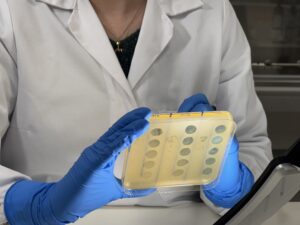
Researchers from Clinical Immunology Services – a PHTA anchor resident – have received £230k of translational funding from Cancer Research Horizons to develop a prototype for a new test to monitor people at risk of developing the blood cancer multiple myeloma.
About 6,000 people in the UK are diagnosed with multiple myeloma each year. The new time-saving test is intended for people with MGUS (Monoclonal Gammopathy of Unknown Significance), a precursor condition of myeloma.
People with MGUS have a 1% chance of progressing to myeloma each year. For this reason, people with MGUS have regular blood tests to check for any changes in their condition – generally every three months at first diagnosis. This monitoring can decrease to every 6 months, or yearly, if the disease remains stable and no new symptoms appear, and currently requires patients to visit general practice or hospital clinics for a blood sample, which is then sent to a clinical laboratory for testing – a process which places burden on both patients and the NHS.
The test – in development by Dr Jennifer Heaney and Dr Sian Faustini at Clinical Immunology Services – will monitor levels of monoclonal proteins, which are produced by abnormal cells in the bone marrow. Increases in monoclonal protein will help to identify those patients who need referral to hospital for further tests to see if myeloma has developed, enabling early treatment, and ultimately making MGUS monitoring more efficient and convenient for patients and the NHS. The prototype is planned to undergo an initial clinical pilot in collaboration with Dr Tracey Chan at University Hospitals Birmingham later this year.
This funding follows a separate investment of £75k from the Cancer Research Horizon’s Data Innovation Award, which is supporting the development of the Integrated UK Myeloma Trials Resource, based on a wealth of data and samples accumulated by Clinical Immunology Services. Read the story here: Clinical Immunology Services Datasets To Advance Myeloma Research