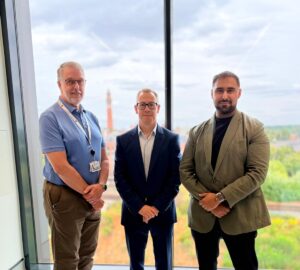
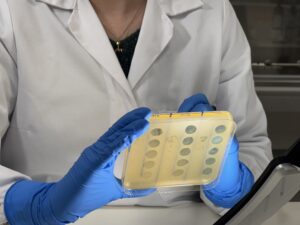
PHTA’s CEO Professor Gino Martini and Industry Trials Hub Lead Becky Bishop were recently interviewed for the Nov/Dec edition of Birmingham Business, which featured a special report on the region’s life sciences sector.
When the Precision Health Technology Accelerator is declared officially open for business at the beginning of 2025, Professor Gino Martini and his team will be spearheading a state-of-the-art facility which is set to provide a huge shot in the arm for the life sciences sector and the city in general. HENRY CARPENTER catches up with him shortly before the project crosses the finishing line.
It won’t have escaped the notice of thousands of motorists that something big has been brewing at the former derelict factory site in Selly Oak, just below the retail park. What they have been witnessing on their travels is the development of the Birmingham Health Innovation Campus which – it is no exaggeration to say – has the potential to establish the city’s credentials as right at the top of the UK’s leading life sciences economic hubs.
It sits smack in the middle of Birmingham’s medical heartlands where much of the city’s life sciences activity operates. The 10-acre brownfield site lies just a few hundred yards from the QE and within spitting distance of many other healthcare-related institutions. With the main campus of the University of Birmingham and its medical school all a stone’s throw away, academics, business owners, researchers and clinicians – and, lest we forget, the NHS – sit cheek by jowl in this healthcare ecosystem.
And if the life sciences industry has on the face of it been something of a sleeping giant, the development of BHIC is a symbol that it is waking up. The estate is a world-class life science campus which will establish the city as a leading economic hub for life sciences.
It is being delivered through a collaboration between the University of Birmingham and developer Bruntwood SciTech. Several years in the making, the f irst phase of the campus is on the cusp of completion with the first tenants expected to be in place early in 2025.
The top three floors of the seven-story building will be occupied by the Precision Health Technology Accelerator, a 70,000 sq ft facility which is the anchor tenant of No. 1 BHIC. It is the largest accelerator in the UK for the life sciences sector, and its strapline is ‘empowering health innovation’. It has not been without its hiccups, but now the finishing line is in sight the levels of anticipation among its stakeholders, not to mention the team tasked with operating it, are sky high.
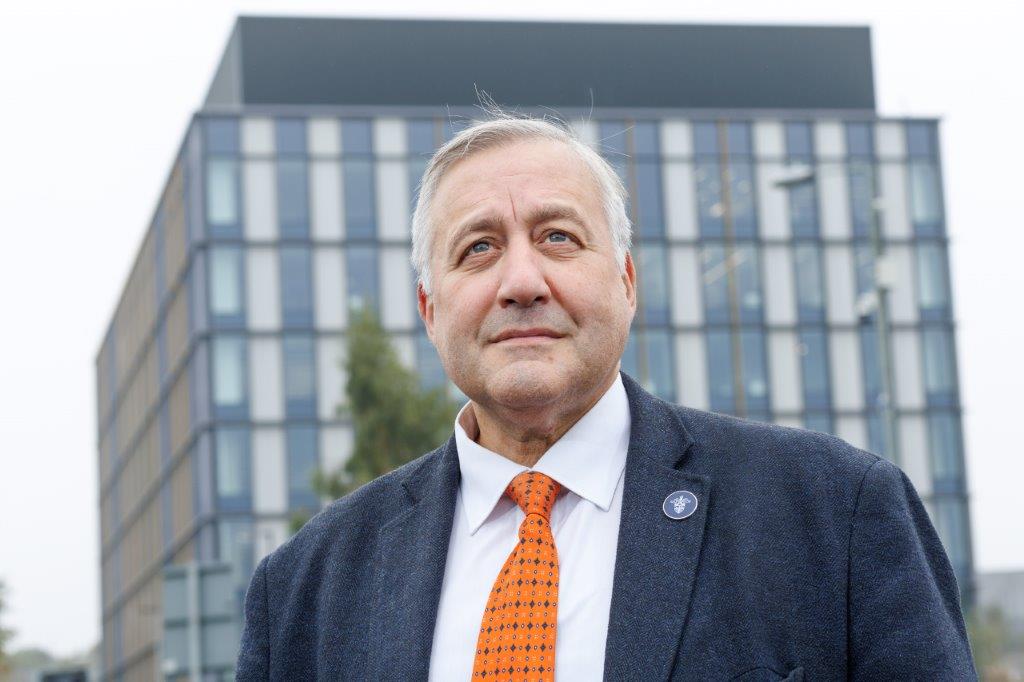
Enter Professor Gino Martini, the chief executive of the PHTA. Martini is an engaging character with both the credentials and character traits his employer, the University of Birmingham, was looking for to oversee this enormously important project. This is a plain-speaking scouser who is unafraid to call a spade a spade or roll up his sleeves in the quest to get things done. He’s a doer, and it’s easy to see why he was given the job of delivering a world-class commercial hub for the life and health sciences. We’ll come to his formidable CV a little later.
It is a drizzly autumn day when we meet, but Martini’s face lights up when he discusses the reasons why he took on the PHTA CEO role. Having worked in London, Oxford and other better-known life sciences centres, Martini wasn’t sure what to expect when he arrived for the interview. By his own admission, he had little idea what Birmingham had to offer as a city or its prospects as an epicentre for the industry. “I remember doing the interview with the university, and then realising I was the favoured candidate,” he recalls. “They took me out for a walk around the area. At the end of it, I asked two questions. The first was where do I sign? The second was, where have you guys been?
“My point was that there is a great deal more to the region than manufacturing. It has a fantastic life sciences heritage across the region, it has the biggest hospitals, a huge and diverse patient population, you’ve got Birmingham Health Partners and huge trusts all united in a common cause – and that’s what we are able to access.” We are looking at a computer-generated image of how the 10-acre site is projected to look on completion – and this gives a clue as to what prompted his enthusiasm.
“What we are selling is an ecosystem as part of a magnificent master plan. The BHIC covers this 10-acre site and this is phase one,” he adds, pointing to a seven-storey block at the hospital end of the campus. “But look at the ecosystem. You’ve got one of the largest hospitals in the UK, a private hospital, a medical school, various medical institutes, the university and its train station…it’s just so unique both in term of scale and what we’re doing.”

Which is what, exactly? We get the part about the campus as a whole, but what will the PHTA specifically be offering? In terms of the basic physical environment, there are wet and dry laboratories, flexible office spaces, prototype and small-batch manufacturing facilities, training suites, meeting spaces and so forth. But this is before the human involvement – the clinical expertise, the talent pool, the commercial experience – which when combined with the environment is expected to create a world-class ecosystem.
“When you work with PHTA, you’re not just renting space,” says Martini. “You’re tapping into the expertise of a thriving cluster of health excellence, infrastructure, clinical leadership and entrepreneurial skills. You’re harnessing the power of existing partnerships between the NHS, academia, citizens and industry partnerships to deliver innovation in therapies, diagnostics and devices at pace and scale. It is a signature life science research facility, and provides a route for businesses to access integrated health innovation assets.
“What we’re trying to do is create a national and international resource where people come and work together. It’s about collaboration, with businesses of all sizes from the worlds of biopharma and med-tech partnering with PHTA’s clinical-academic teams to integrate, analyse and interpret data sets and basic science. PHTA will allow our industry partners to rapidly develop, test and validate new products and services.”
I wonder what the profile of the PHTA tenants is likely to be. The likelihood is that it will be a variety of businesses, large and small, some from the region, many from further afield including overseas, all wanting to tap into the expertise, collaborative spirit and perfect geography to commercialise ideas and accelerate the development of therapies and technologies. In many ways, despite seeing the PHTA through from concept to completion, Martini’s work has only just begun. He is responsible for helping growing businesses to succeed, through making connections to multi-disciplinary opinion leaders and providing commercialisation support and expertise.
You would be hard stretched to find someone as qualified as Martini for the job in hand. His CV is almost bespoke for the role, encompassing as it does the worlds of industry, academia and the public sector. He joined PHTA from the Royal Pharmaceutical Society where, as chief scientist, he played a pivotal role in supporting pharmacists during the pandemic. An experienced academic and industrial pharmacist, he has extensive expertise in oncology, rare and infectious diseases, and drug development – as well as policy development and external advocacy.
His career began with senior scientist roles at Scherer Drug Delivery Systems and SmithKline Beecham, before joining GSK where he rose to senior directorship roles within a 10-year stint. His academic credentials are scarcely less impressive. Formerly professor of pharmaceutical innovation at King’s College London, he also has an MBA specialising in SME success and business failure – awarded with distinction from the University of Liverpool.
He is a past chair of the Industrial Pharmacists Group of the Royal Pharmaceutical Society, and past president of the European Industrial Pharmacists Group. Believe it or not, that is only a summary – but it does give an idea why the University of Birmingham was so keen to appoint him.
“One of the reasons why I was approached was because I’d worked in industry, academia and a public body, and also because I’ve done a lot of work in building ecosystems,” he says. “They wanted someone who could act as a conduit between academia and industry, and someone to try to bring skills from one sector to the other.”
The PHTA is fulfilling other roles of huge benefit to the economy of the region. One of these is providing space for start-ups to breathe and grow; too many have left the region. It is also helping to meet demand. There is a massive shortage of brand-new laboratories with most organisations using existing buildings or old pharma sites. Martini reckons that there’s a shortage of one million square feet of bespoke laboratory space in Oxford, and a similar amount in Cambridge.

As well as the raft of collaborative and commercial opportunities the PHTA is expected to open up, it will also be fulfilling essential clinical purposes of benefit to society as a whole. We are joined by one of the key members of the PHTA team, Becky Bishop, who is the accelerator’s Industry Trials Lead, and she will be operating from the third floor of the accelerator where she will be working with industry to design complex trials for cancer.
As she says, clinical testing is a crucial part of the healthcare pathway, and people will be “able to access the NHS, access clinicians devising diagnostic tests, access great brains and cancer clinical trials testing; we have training space on the fourth floor…when you think about it, it’s really exciting.” She is similarly enthusiastic about the geography of the PHTA. “We have got the largest paediatric oncology trials unit in the region right here at the University,” she says.
She also makes the point that it is not just the size of the patient population which provides the life sciences industry with real ballast, but also its diversity in gender, age and backgrounds. “There is a real stability to the population here. There are 90 languages spoken, and 40 per cent are below the age of 16 which makes it a really unique community.
“A new medical device or new therapeutic will not come onto the market without testing it for patients’ safety. It just doesn’t happen.” Bishop says that a number of industry heavyweights have already signed up to collaborate over trials, and one major tenant is the university’s Clinical Immunology Services. This, we are told, “provides a comprehensive range of accredited lab services to facilitate NHS diagnostic testing, clinical trials and the development of new diagnostics”. It is also a major testing centre for various diseases.
While he has a pride in the PHTA, the wider campus and the city’s life science’s sphere as a whole, Martini is a firm advocate for collaboration with the likes of Oxford and Cambridge – for the good of healthcare in general. “We should stop competing as silos and should instead form regional superclusters,” he says. “We should be working co-operatively and collaboratively in a way to solve problems for the nation in healthcare and life sciences. “Boston has an eight-mile-long innovation zone. Go to China and it takes an hour just to leave the innovation zone. That’s how big these things are. We can compete because of our fantastic academics and our ability to collaborate across the region. That’s my wider ambition.”
He is also quick to praise the University of Birmingham and the PHTA board of directors. “While the PHTA is a subsidiary of the university, there has been no pressure to fill the facility quickly – it’s about filling it right. It has got to be right for the ecosystem and the nation. “We’re about 50 per cent full and I’m not unhappy with that, given the obstacles and challenges we have had to face. But this is a long-term strategic play, and the university and the PHTA Board have been really supportive.”
I get the impression that it has been a tiring, at times exasperating, few years for Martini and his team, and occasionally it has felt like he has been pushing a rock uphill. But, overall, there must be enormous satisfaction in what he has achieved.
“If they wanted someone just to rent out space they would have got a real estate professional with a letting background in to do it. This job is very varied, from overseeing a building to choosing the tenants, managing expectations, understanding service charges, tenancy, and even choosing furnishings.” All of his work in getting the project to this stage has now come to fruition, so what are his overriding emotions now that he has reached the finishing line? A pause. “Trepidation,” he says slowly. “Trepidation fused with real excitement. I just want to deliver it really, really well.”