Ahead of the Greater Birmingham Chamber of Commerce Awards, where we’ve been shortlisted in the Pioneer category, we spoke to CEO Professor Gino Martini about the vision behind the facility, the partnerships that helped bring it to life, and its role in supporting the next generation of health and life sciences businesses in Birmingham.
From shaping a purpose-built home for innovators, researchers and clinicians, to tackling the UK’s shortage of lab space and creating opportunities for local people, Gino reflects on what it takes to build an ecosystem designed to help ideas move from concept to patient impact…
What role did you play in developing this project?
I was appointed CEO of PHTA in October 2021, at roughly the same time as Bruntwood SciTech and the University of Birmingham broke ground on our home site, Birmingham Health Innovation Campus. The first phase of the development was centred around PHTA from the outset, and I was excited by the opportunity to create a hub where like-minded individuals and businesses could converge, connect and collaborate.
One of the reasons I was approached was because I’d worked in industry, academia and a public body, and also because I’ve done a lot of work in building ecosystems – the university wanted someone who could act as a conduit between academia and industry, and someone to try to bring skills from one sector to the other. We were emerging from COVID-19 back then, which showed us that hybrid and multidisciplinary models of working really do work, and that was my vision for the PHTA – an ecosystem which crosses boundaries and taps into expertise from the worlds of academia, industry and clinical medicine.
Even before opening, the job has been very varied – from overseeing the build to choosing the residents, managing expectations, understanding service charges, tenancy, and even picking furnishings.
Was there a moment when you thought, “This could really work”?
When I interviewed for the job, I wasn’t sure to expect, as I didn’t know much about what it could offer as a city or to the life sciences sector. They took me for a walking tour of the area – Birmingham’s health and life sciences district – with not only a redbrick Russell Group University, but also one of the largest hospitals in the UK, a private hospital, Birmingham Women’s Hospital, and a Medical School that graduates 400 doctors every year. It’s just so unique in terms of scale and opportunity, so at the end of the tour I asked two questions: The first was where do I sign? The second was, where have you guys been?
Who supported you along the way?
I have an incredible team, some of whom have been involved from the beginning and have helped shape PHTA into what it is today.
Support from the University took many important forms – firstly we are a wholly-owned subsidiary, so to have the financial backing of such a world-class institution is invaluable. Secondly, we knew we wanted the building and PHTA’s facilities to be designed by scientists, for scientists, and we were fortunate to be able to recruit many academics to our advisory boards. We worked with experts in translational medicine, pharmacy, cancer, genomics, engineering, medical technology, clinical trials…the list is endless. We needed to make sure the spaces we created would work for them, and as a result I’m proud to say we became the new home for the University’s Clinical Immunology Services, led by Professor Alex Richter.
Our board has been a great source of inspiration and strategic direction over the past few years. Two of our board – Clive Dix and Steve Chatfield – are former members of the UK’s Vaccine Taskforce with vast experience of establishing and growing pharma and biotech businesses, while our Chair Jo Pisani is a highly-experienced advisor to charities, universities and business start-ups alike.
And needless to say, operationally we were very well supported too, from project management from the University’s Estates team led by Dan Holmes, to strategy direction from Dr Steve Taylor, who led the project from its inception to my appointment. Almost every team in the University played some role, from finance and legal to public affairs and communications.

What’s something people wouldn’t realise happens behind the scenes?
As a small but agile team, everyone is hands-on and gets involved with everything. From giving tours to prospective customers, supporting our residents, tackling maintenance snags and hosting events, we all pull together to make this a success.
We’re also a flagship building for the University and attract a lot of interest from regional stakeholders, so it’s not uncommon to find government ministers, local MPs and other dignitaries coming along for a visit or hosting events here.
Finally, anyone that travels past BHIC on the A38, Cross-City Line or canal might have noticed there is still construction work going on. This is because we’ll soon be joined in the building by B-CASCS – the University’s Birmingham Centre for Anatomy, Surgical and Clinical Skills. Medical, nursing and midwifery students will be here learning the practical elements of their future careers, from taking blood and inserting cannulas to homebirths and routine observations. There’ll be mock wards, a fully equipped theatre, and immersion rooms with VR and AR, as well as anatomy labs and teaching rooms. We’re incredibly excited to share the space with students and their instructors, and are ready to support them with internships, research placements and helping them start up their own companies.
What part of this achievement are you personally proudest of, and how do you hope it will impact people, industry, or the region?
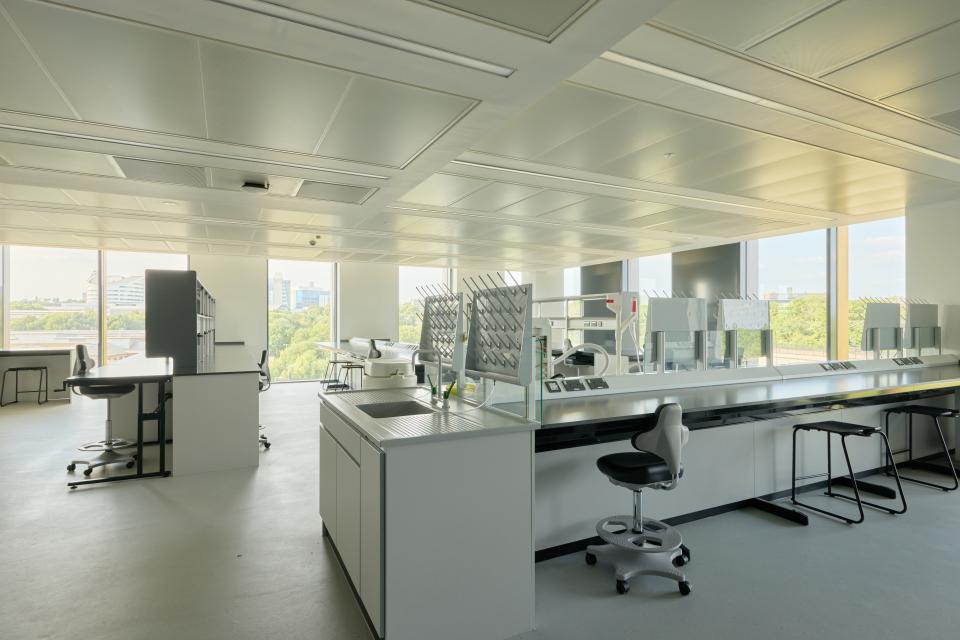
There is a massive shortage of lab space in the Midlands and people might not realise what impact that has – new start-ups in health and life sciences have nowhere to scale to, so they end up leaving the region or even the country to find the labs they need, even when they don’t want to relocate. The region then misses out, not only in terms of job creation and attracting investment, but patients also lose the opportunity to take part in potentially groundbreaking clinical trials. Having purpose-built labs gives new businesses space to breathe and grow – creating high-skilled jobs and economic benefit in our region, and enabling local people to be part of research.
Beyond that, our ambition is to become an anchor institution for reducing health inequalities. We want to upskill people in the local community to help them secure some of the 10,000 jobs that PHTA and BHIC are set to create, and have recently partnered with Selly Oak MP Al Carns to offer local schools the chance to bring students into our Makerspace to learn about 3D printing, additive manufacturing, product design and medtech. We want our training suite to be open to charities and social enterprises who are supporting local people, and we want to contribute to making clinical research as widely-accessible as possible.
We are only a short drive away from Bournville where the Cadbury family invested in the local community and their wellbeing, and PHTA will do the same.