A pioneering partnership between the University of Birmingham’s Clinical Immunology Services (CIS) and the University of Illinois Urbana-Champaign is driving forward a new generation of ultra‑sensitive, affordable diagnostic technologies aimed at reducing global health inequalities.
The diagnostic divide between the Global North and Global South continues to limit access to essential tests, with nearly half of the world’s population still facing significant barriers to timely and accurate diagnosis. Effective tools for detecting infectious diseases require high sensitivity and specificity but also must be low‑cost and deployable directly within communities.
Researchers at CIS and Illinois are addressing the challenge by combining cutting‑edge nanotechnology with leading immunodiagnostic expertise. Their hybrid approach will help to help bring laboratory‑quality performance to rapid point‑of‑care testing.
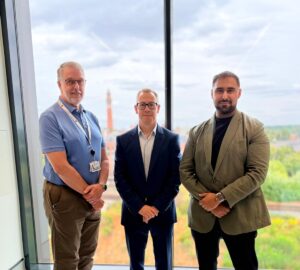
Dr Jen Heaney was a member of a University of Birmingham delegation visiting Illinois when she met Dr Xing Wang, from the Department of Bioengineering at UIUC.
Dr Heaney, from Clinical Immunology Services based within PHTA, said: “As we explored shared priorities in global health, we recognised the potential to merge US biotechnology innovation with UK strengths in translational diagnostics.
“Our partnership is growing rapidly, not only scientifically but in its global reach. By working together across disciplines and continents, we aim to ensure technological innovation translates into meaningful real‑world impact.”
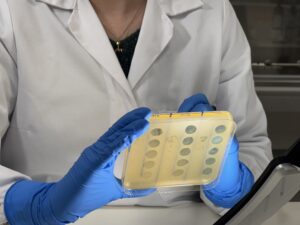
The team quickly advanced joint funding applications to begin developing new technical approaches. Their current project centres on novel nanotechnology‑enabled detection strategies for HIV, designed to deliver rapid and ultra‑sensitive results.
Dr Wang said: “This invaluable and timely collaboration with a medical immunodiagnostic expert, Dr. Heaney and her group, offers the team a great opportunity to realise the potential of the DNA nanotechnology-based virus diagnostics in real-world applications”
A one‑month international exchange, funded by the Biotechnology and Biological Sciences Research Council, allowed the researchers to establish the technology platform in the UK and complete a clinical evaluation using a UK biobank.
The collaboration has since secured further support through the BRIDGE Signature Initiative to expand its portfolio of sensing strategies and prepare a joint publication.
Building on this momentum, the team is submitting additional funding bids to further develop the HIV test and start work on diagnostics and surveillance tools for vector‑borne diseases.
With a widening network of international partners and a shared mission to improve equity in diagnostic access worldwide, the Birmingham–Illinois collaboration is poised to shape the future of accessible, high‑performance testing technologies.