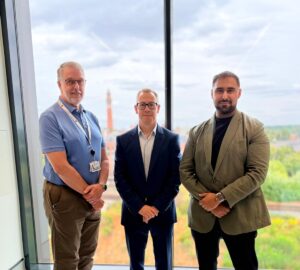
In a column for WM News, Professor Neil Hanley of the University of Birmingham sets out how Birmingham is establishing itself as a world-class life sciences hub that is essential to the UK’s national offering in this fast-growing sector.

Colleagues from across Birmingham headed to London Life Sciences Week recently with a very simple message: we are here to work alongside the ‘Golden Triangle’ to bring prosperity to the UK’s Life Sciences industry.
Fresh from hosting Jason Stockwood, Minister for Investment in the Department of Business & Trade, as part of the Government’s recent Investment Summit in Birmingham, we brought evidence of what a regional engine looks like when it decides to power up.
Back in September, as University of Birmingham (UoB) lead, I was proud to launch Birmingham Health Innovation Campus (BHIC) – which is scheduled to create 10,000 jobs and deliver £400 million in economic value by the 2030s – with Chris Oglesby, chief executive of our partner, Bruntwood SciTech.
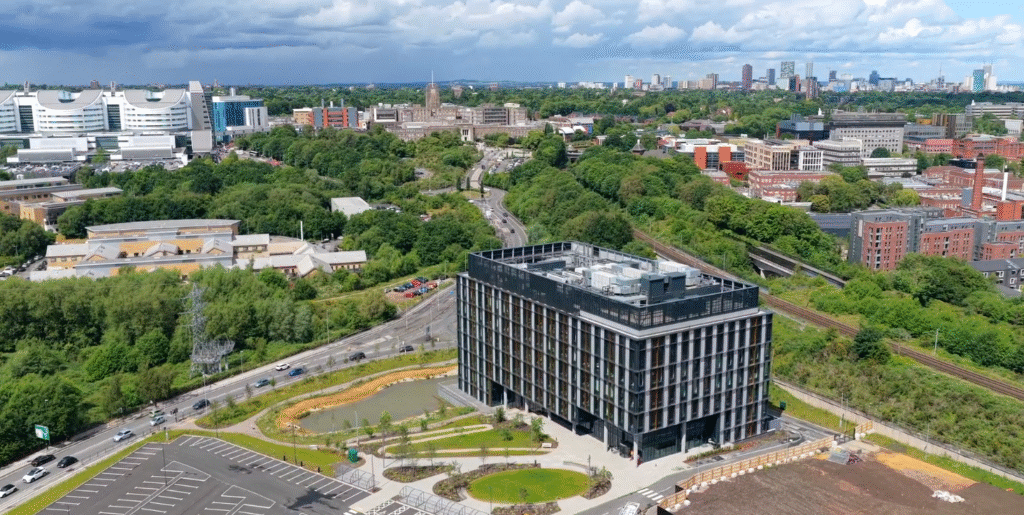
At this launch, we officially opened No.1 BHIC, the campus’s first phase – 133,000 square feet of world-class life sciences space. This isn’t just about the £100 million investment in the new building and its facilities; it’s about what happens when a place decides to elevate its ambition and coalesce nationally- and internationally-leading assets in healthtech, genomics, diagnostics and clinical trials to target inward investment into the heart of the country.
Our anchor tenant in No.1 BHIC is the Precision Health Technologies Accelerator (PHTA), which brings new state-of-the-art incubation and collaboration space for ambitious start-ups and scale-up SMEs alongside clinical diagnostics expertise that led the way as the only ‘pillar 2’ lab run by a university during the pandemic. With the Minister, we visited PHTA’s Makerspace, a prototyping and small-batch manufacturing facility, where the team was 3D printing a replica heart.
One of the best spin-out stories never told
PHTA and BHIC sit within Birmingham’s wider health and life sciences district – an area of more than a square mile, turning over nearly £5 billion annually and home to the city’s two largest employers, University Hospitals Birmingham NHS Foundation Trust and UoB, a global top 100 university. The district holds one of the best spin-out stories never told.
The Binding Site started out of UoB 40 years ago in immunology diagnostics and has achieved that Government mission – scaling to global relevance while staying put in the UK. Its discoveries rapidly informed (and remain in) international clinical guidelines; it turns over £200 million per year, works in 87 countries, employs 1,200 people (700 in the UK) and when acquired by ThermoFisher in 2022 at 19-fold, was the greatest ever return-on-investment for its backer, Nordic Capital. As we wave the flag for the UK, we need to tell these compelling success stories cohesively – a place that agglomerates its leading assets, people and know-how, to become a destination.
Building in regional resilience
None of this is arguing against the capital’s strong messages from London Life Sciences Week. The UK must retain the enduring success of London, Oxford and Cambridge. This is about synergy, symbiosis and growth – futureproofing the sector and building in resilience. The UK’s uncomfortable reality is that over-reliance on the economy of the greater south east makes it an outlier amongst leading countries. Rent is high, house prices are unaffordable and graduate talent pipelines in London are more migratory; even fresh water supply has become a challenge for city planning in Cambridge.
Major conurbations like Birmingham offer more affordable living, easier commuting and cheaper workplace rents – I recently visited Kendall Square tenants in Cambridge, Massachusetts and heard of ten-fold higher lab rental costs than in BHIC.
The Government’s commitment to a more distributed approach is welcome with several mayoral authorities championing their strengths in health and life sciences. It is our job to provide the facilities, expertise and talent pipeline.

Training 2,000 doctors
At any one time, UoB’s Medical School is training nearly 2,000 future doctors, 1,500 biomedical and biological scientists and, within a couple of years, 1,000 pharmacists. For the second year running, the university has ranked first in the UK at attracting top graduate employers. Innovative partnerships in health and life sciences – for example the £3 billion regeneration project in East Birmingham led by Birmingham City Football Club and Knighthead Capital Management – bring their own synergy within the city.
Birmingham is one of the youngest cities in Europe, and having Britain’s most diverse, stable population also brings practical as well as cultural advantage. It means research conducted through our clinical trials units not only deliver health improvements in populations that are often underserved, they also generate samples and data that reflect the wider world.
This matters commercially: globally relevant data unlocks wider regulatory approval and larger markets. We are stitching this work together so our comprehensive data in the West Midlands Secure Data Environment, genome-scale diagnostics from our leadership of the Central & South Genomics (10 million people across to Oxford and down to the south coast), our clinical trials (UoB’s Cancer Research UK Clinical Trials Unit is a national leader for childhood cancer) and our expertise in regulatory science (leading in AI through CERSI AI) brings to life the Government’s ambition for faster, more effective clinical research.
Complementing the Golden Triangle
Very few, if any places, have this complete yet; Birmingham’s current £200 million a year of new research awards in health and life sciences is under-appreciated, creating a £1 billion five-year cycle, but we are aiming to be yet more ambitious – advancing an offer to industry that complements the assets and skills in Oxford, Cambridge and London.
Recognising these opportunities, the West Midlands Combined Authority (WMCA) and the WM Growth Company have swung behind our work with health and life sciences now one of its key sectors. Their support has made a big difference drawing together health and the economy as well as regional and central Government. A good example of this co-working is the opportunity offered by the Government’s current Local Innovation Partnership Fund, where large mayoral authorities can bid for £50m to pull together public, industry and university sectors and create engines for growth.

Birmingham’s health and life sciences district – part of the national conversation
So, our conversations at London’s Life Sciences Week were straightforward: Alongside the great opportunities that are well-publicised in the Golden Triangle, there is an exciting opening right in the middle of the country in Birmingham’s health and life sciences district.
We must continue to raise its visibility, ensuring investors and industry recognise what is already in place and what working together might unlock for the future. The UK is of a scale where a diversity of places can thrive and synergise, demonstrating that regional growth is more than just a soundbite.
- Professor Neil Hanley is Pro-Vice-Chancellor and Head of the College of Medicine and Health at the University of Birmingham; Executive Director of Birmingham Health Partners; and UoB Lead for Birmingham Health Innovation Campus.